
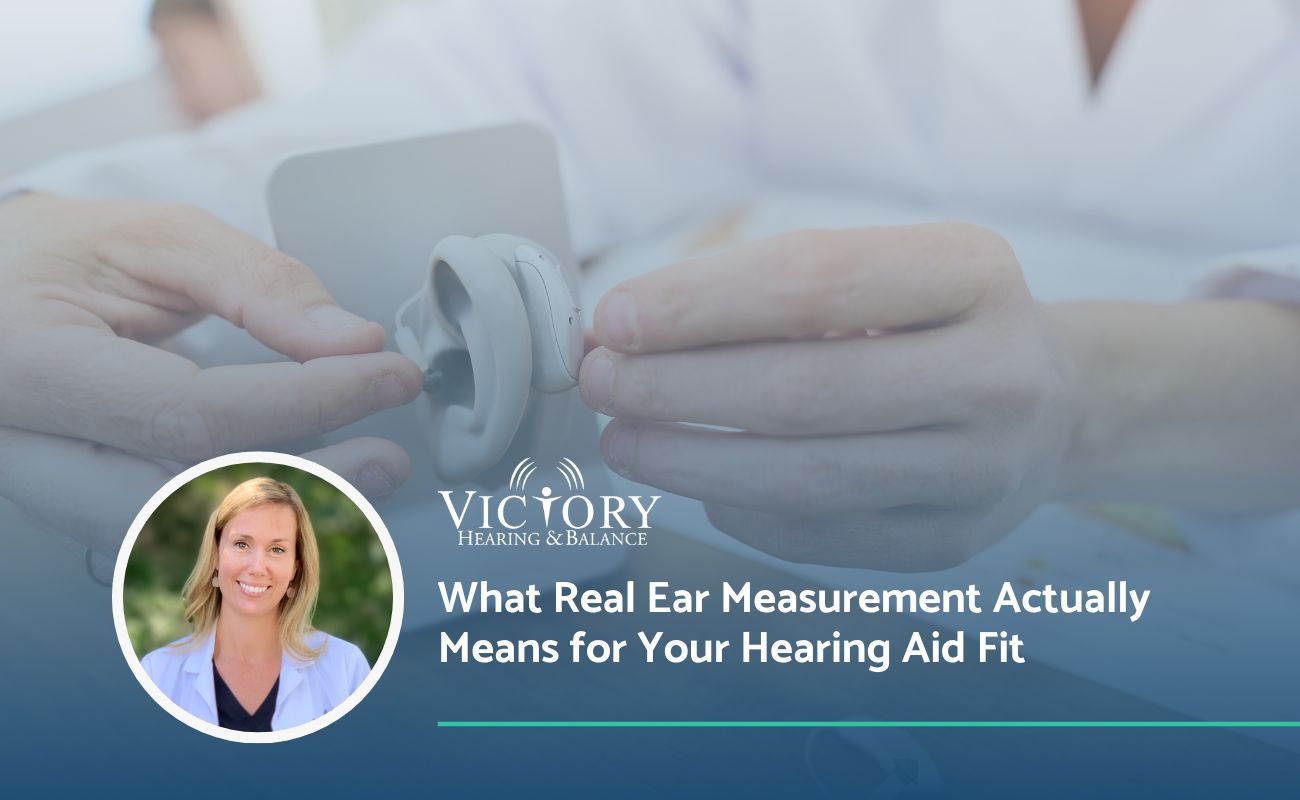
What Real Ear Measurement Actually Means for Your Hearing Aid Fit
Real Ear Measurement verifies that hearing aids are precisely calibrated to each patient's unique ear canal rather than relying on generic software predictions.
You picked out your hearing aids. They got programmed. So why do some people walk out still feeling like something's off? More often than not, it comes down to one skipped step: confirming that your hearing aids are actually doing what the software says they should within your specific ear.
That step is called Real Ear Measurement, or REM. At Victory Hearing & Balance, it's standard at every fitting.
No Two Ear Canals Are the Same
Hearing aid software makes a prediction. Based on your hearing test and the device you're wearing, it calculates settings that should give you the right level of amplification. This is a reasonable starting point, but it is still a guess because the software has no idea what your ear canal actually looks like.
Canal length, shape, and volume vary more than most people expect. Two patients with nearly identical hearing loss can need noticeably different settings once the hearing aids are in their ears, simply because sound behaves differently in different canal sizes. Skip this step and you're trusting a formula built for a generic ear that doesn't belong to anyone in particular.
How Real Ear Measurement Works
We place a thin probe microphone in your ear canal alongside your hearing aid, about six millimeters from your eardrum. Then we play speech sounds at soft, average, and loud volumes and measure exactly what's reaching your eardrum at each frequency. This allows us to see what is actually happening rather than what the software predicts.
We compare those measurements against research-based targets and adjust your settings until they align. Soft sounds should be audible without feeling intrusive. Loud sounds should stay comfortable. Speech across the frequency range needs to land where your ear can actually use it. The whole process takes roughly ten minutes per ear.
What Happens When Hearing Aids Skip Verification
Here's something worth knowing: hearing aids that were never verified can measure fine on paper and still leave you underwhelmed. Speech sounds muffled, certain tones feel too sharp, and background noise seems louder than it should be. People often assume the hearing aids just aren't right for them, when really, the settings were never confirmed against their actual ear.
The American Academy of Audiology and the American Speech-Language-Hearing Association both recognize REM as the standard of care. Patients consistently prefer the sound quality that comes from verified settings, and that preference is even more pronounced with complex hearing losses, where getting amplification right across every frequency band matters most.
Brand Doesn't Change the Need for Verification
We use REM regardless of which brand you're wearing, such as Oticon, Phonak, or anything else we carry. A device like the Oticon Zeal, built around always-on AI processing, still depends on accurate real-ear verification to perform the way it's designed to. The most advanced chip available can't compensate for settings that were never checked against your ear canal.
The same goes for Phonak's current lineup. The technology inside any hearing aid is only half the equation. The other half is making sure it's calibrated to you specifically.
What to Expect at Your Fitting Appointment
If you're new to hearing aids, or you've had them fit somewhere else without this step, the appointment is straightforward. Probe placement is quick and painless. You'll hear some test sounds through a speaker while we monitor the readings in real time.
Your feedback matters throughout the process. What the measurements show and what you actually hear work together. We make adjustments right there until both line up. That's also why REM is built into our [hearing aid fitting](https://victoryhearing.com/services/hearing-aid-fittings) process as a standard step rather than something you'd have to ask for.
Ready for a Fitting That's Verified for Your Ear
Plenty of hearing aids get sold without ever being tested in the ear they're supposed to serve. Dr. Jill Davis and the team at Victory Hearing & Balance built our protocol around REM because guessing isn't good enough for something you'll wear every single day.
Whether you're exploring hearing aids for the first time or you've been disappointed with a previous fitting somewhere else, this is often the difference that explains why. If you're in West Lake Hills, Hutto, or anywhere in the greater Austin area, call us at 512-443-3500. We'd be glad to walk you through it.
Schedule a Consultation Today!
Contact Victory Hearing & Wellness for more information about their comprehensive wellness programs and services.